






Introduction
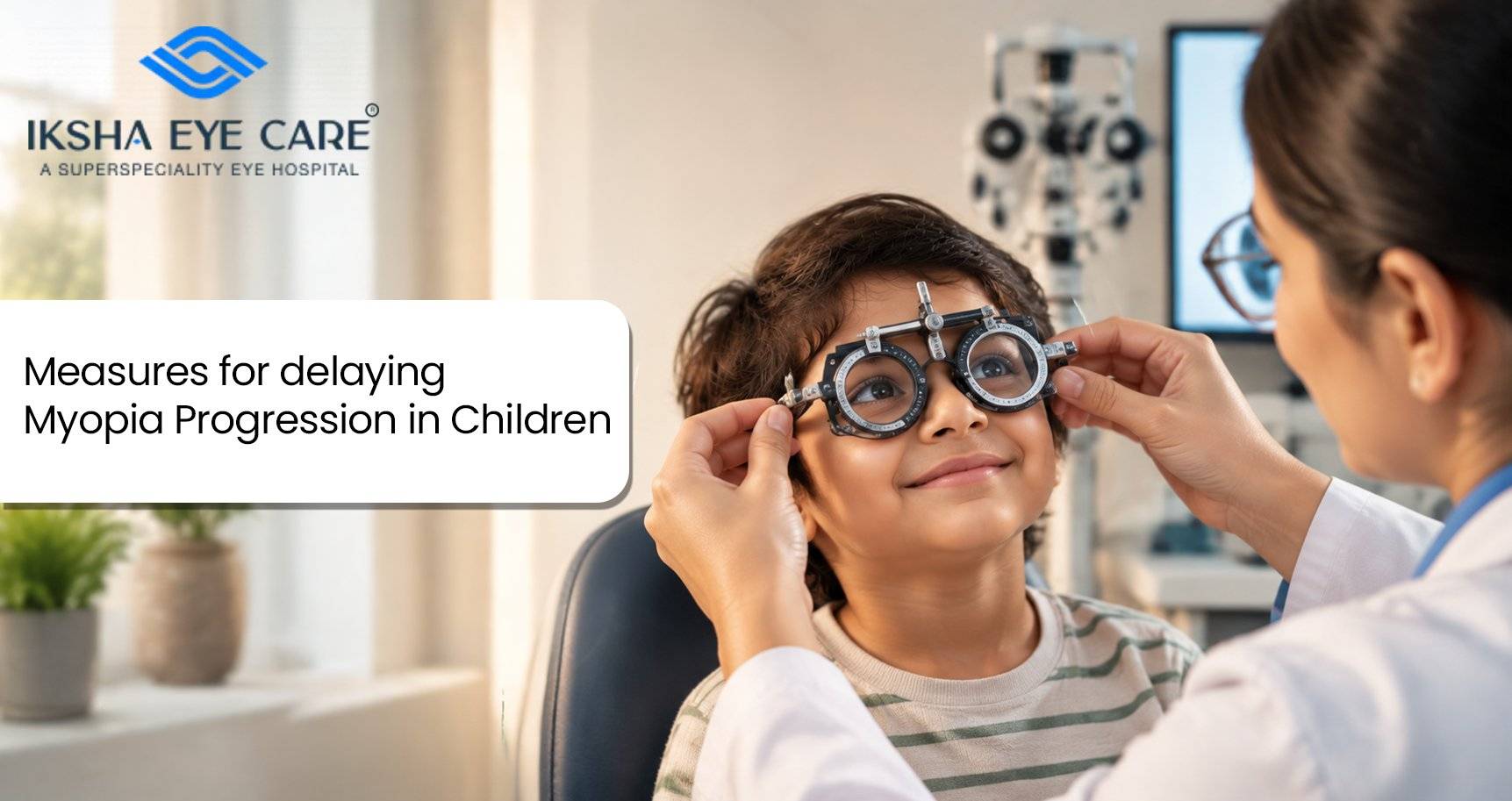
Myopia Progression in Children is becoming an increasing concern for parents, schools, and eye-care professionals. Myopia, commonly known as short-sightedness, makes distant objects appear blurred and can progress as a child grows. Early-onset myopia is particularly important because children who become myopic at a younger age have more years in which the condition can progress. Genetics, reduced outdoor exposure, prolonged near work, and certain visual habits can contribute to the risk.
The good news is that Myopia Progression in Children can often be managed with a combination of healthy visual habits, regular eye examinations, and clinically appropriate myopia-control treatments. At Iksha Eye Care, parents can seek specialised assessment and guidance from experienced eye-care professionals to determine an appropriate management plan for their child.
What Causes Myopia Progression?
Understanding what causes Myopia Progression in Children is the first step towards effective management. Myopia generally occurs when the eye becomes too long from front to back, causing light to focus in front of the retina rather than directly on it.
Several factors can increase the likelihood or speed of progression:oi
- Early age of onset: Children who develop myopia at a younger age are more likely to experience faster progression.
- Family history: Having one or both myopic parents can increase a child’s risk.
- Limited outdoor time: Children who spend less time outdoors have a higher risk of developing myopia.
- Prolonged near work: Reading or using digital devices for long periods, particularly at very close distances, may contribute to risk.
- Visual environment: Insufficient natural light and fewer opportunities to look at distant objects may also play a role.
Importantly, parents do not necessarily need to eliminate reading, homework, or screen use. Instead, children should have regular breaks, maintain a comfortable working distance, and spend adequate time outdoors.
Myopia in Child Treatment: What Are the Options?
Myopia in child treatment should be personalised according to the child’s age, prescription, rate of progression, eye health, lifestyle, and family history. Simply changing glasses whenever the prescription increases may correct blurred vision, but it does not necessarily address the underlying progression.
Depending on the child’s needs, an eye specialist may consider:
1. Myopia-Control Spectacles
Specially designed spectacle lenses can help manage myopia progression by altering the peripheral visual focus. Certain modern lens designs have demonstrated benefits in reducing both refractive progression and eye elongation.
2. Low-Dose Atropine
Low-concentration atropine eye drops are among the medical approaches studied for controlling childhood myopia. Research indicates that different concentrations can have different levels of effectiveness, and treatment should be selected and monitored by an eye-care professional.
Parents should not start atropine without professional advice because concentration, duration, response, side effects, and follow-up requirements need to be considered.
3. Specialised Contact Lenses and Orthokeratology
Multifocal or myopia-control contact lenses and orthokeratology may be considered for selected children. Orthokeratology involves specially designed lenses worn overnight, but strict hygiene, fitting, follow-up, and safety monitoring are essential.
How to Stop Myopia Progression in Children
Many parents ask how to stop myopia progression in children completely. At present, there is no single treatment guaranteed to permanently stop progression in every child. The realistic goal is to slow progression and reduce excessive elongation of the eye.
Parents can support their child’s eye health by:
- Encouraging regular outdoor activity.
- Following the prescribed spectacle or contact-lens correction.
- Taking frequent breaks during prolonged near work.
- Avoiding very close reading distances.
- Maintaining appropriate lighting while studying.
- Scheduling regular comprehensive eye examinations.
- Following the recommended myopia-control treatment consistently.
Outdoor exposure is particularly important. Evidence supports increased outdoor time as one of the safest strategies for reducing myopia risk, with international guidance commonly encouraging approximately 80–120 minutes outdoors each day.
Myopia Control in Children
Myopia control in children involves monitoring the child’s prescription and, where appropriate, using interventions designed to reduce the rate of progression. A comprehensive assessment may include visual acuity, refraction, eye health evaluation, and, when clinically appropriate measurement of axial length.
Regular monitoring is important because a child can continue progressing even when the glasses provide clear vision. If progression remains significant, the ophthalmologist may reassess the current strategy and consider modifying or combining treatment approaches. International guidelines emphasise regular clinical review and adjustment when control is inadequate.
At Iksha Eye Care, parents can discuss an individualised approach to myopia management based on their child’s visual needs and progression pattern.
Rapid Myopia Progression in Children: When Should Parents Be Concerned?
Rapid myopia progression in children deserves prompt professional evaluation. Warning signs may include a noticeable increase in the glasses prescription within a relatively short period, difficulty seeing the classroom board, frequent squinting, sitting very close to screens, or complaints of blurred distance vision.
A rapidly changing prescription does not automatically mean that a child has a serious eye disease. However, it indicates the importance of a detailed assessment and ongoing monitoring.
Parents should also be particularly attentive when myopia begins at a young age or when there is a strong family history of myopia. Early identification provides more opportunity to introduce appropriate lifestyle measures and, when indicated, myopia-control treatment.
Slowing Myopia Progression in Children: Practical Daily Habits
Slowing myopia progression in children requires consistency rather than relying on one isolated measure. A practical routine can include:
- Outdoor time: Encourage children to spend meaningful time outdoors every day.
- 20-20-20-style breaks: During extended near work, encourage children to regularly look away and focus on something farther away.
- Comfortable reading distance: Avoid holding books or digital devices extremely close to the face.
- Good lighting: Ensure homework and reading areas are adequately illuminated.
- Correct prescription: Children should use their prescribed correction as directed rather than intentionally wearing weaker glasses.
- Regular check-ups: Monitor changes in refraction and, when appropriate, axial length.
- Treatment adherence: If a specialist recommends atropine, specialised spectacles, or contact lenses, follow the prescribed schedule carefully.
These measures work best when incorporated into the child’s normal routine. International Myopia Institute guidance also highlights the importance of appropriate near-work habits, outdoor activity, and full-time use of prescribed myopic correction.
Why Early Myopia Management Matters
The objective of managing Myopia Progression in Children is not simply to help a child see clearly today. Slowing excessive eye growth may reduce the child’s eventual level of myopia and may help lower the long-term risks associated with high myopia.
Parents should therefore avoid waiting until a child’s prescription becomes very high before seeking advice. An early assessment can establish a baseline and help determine whether the child’s myopia is stable or progressing.
If your child has blurred distance vision, frequent squinting, difficulty seeing the board, or repeatedly changing glasses prescriptions, consider consulting a specialist. A qualified pediatric ophthalmologist in Mumbai can assess the child’s eyes and recommend an appropriate management strategy.
Conclusion
Myopia Progression in Children can be influenced by age of onset, genetics, visual habits, outdoor exposure, and the individual characteristics of the child’s eyes. While no single approach can guarantee that progression will stop completely, early detection, healthy visual habits, outdoor activity, regular monitoring, and evidence-based myopia-control options can help slow progression.
For parents, the most important step is not to wait for worsening vision to become obvious. Regular children’s eye examinations allow changes to be identified early and treatment to be considered when appropriate. Iksha Eye Care provides specialised pediatric eye-care services to help families make informed decisions about children’s vision and long-term eye health.
Frequently Asked Questions
1. What is Myopia Progression in Children?
Myopia Progression in Children refers to the worsening of short-sightedness as a child’s eye continues to grow. It is commonly monitored through changes in refractive error and, where appropriate, axial length.
2. Can myopia progression in children be stopped completely?
There is no guaranteed method that completely stops progression in every child. However, evidence-based myopia-control strategies can help slow progression in suitable patients.
3. Does spending time outdoors help with childhood myopia?
Yes. Increased outdoor time is one of the best-supported lifestyle measures for reducing the risk of developing myopia and is recommended as part of healthy childhood eye care.
4. Are atropine eye drops safe for children?
Low-dose atropine can be an effective option for selected children, but it should only be used under the supervision of an eye-care professional. The appropriate concentration and follow-up schedule vary between patients.
5. How often should a child with myopia have an eye examination?
The appropriate interval depends on the child’s age, prescription, rate of progression, and treatment. Children undergoing myopia-control treatment generally require regular professional monitoring.
6. When should I consult a pediatric ophthalmologist?
Parents should consider an assessment if a child has blurred distance vision, squints frequently, sits close to screens, struggles to see the classroom board, or has rapidly changing glasses prescriptions. A pediatric ophthalmologist in Mumbai can provide a child-focused evaluation and management plan.